
How to Locate a Sewer Line on Your Property | SiteTwin
How to Locate a Sewer Line on Your Property (and Why 811 Won't Mark It)
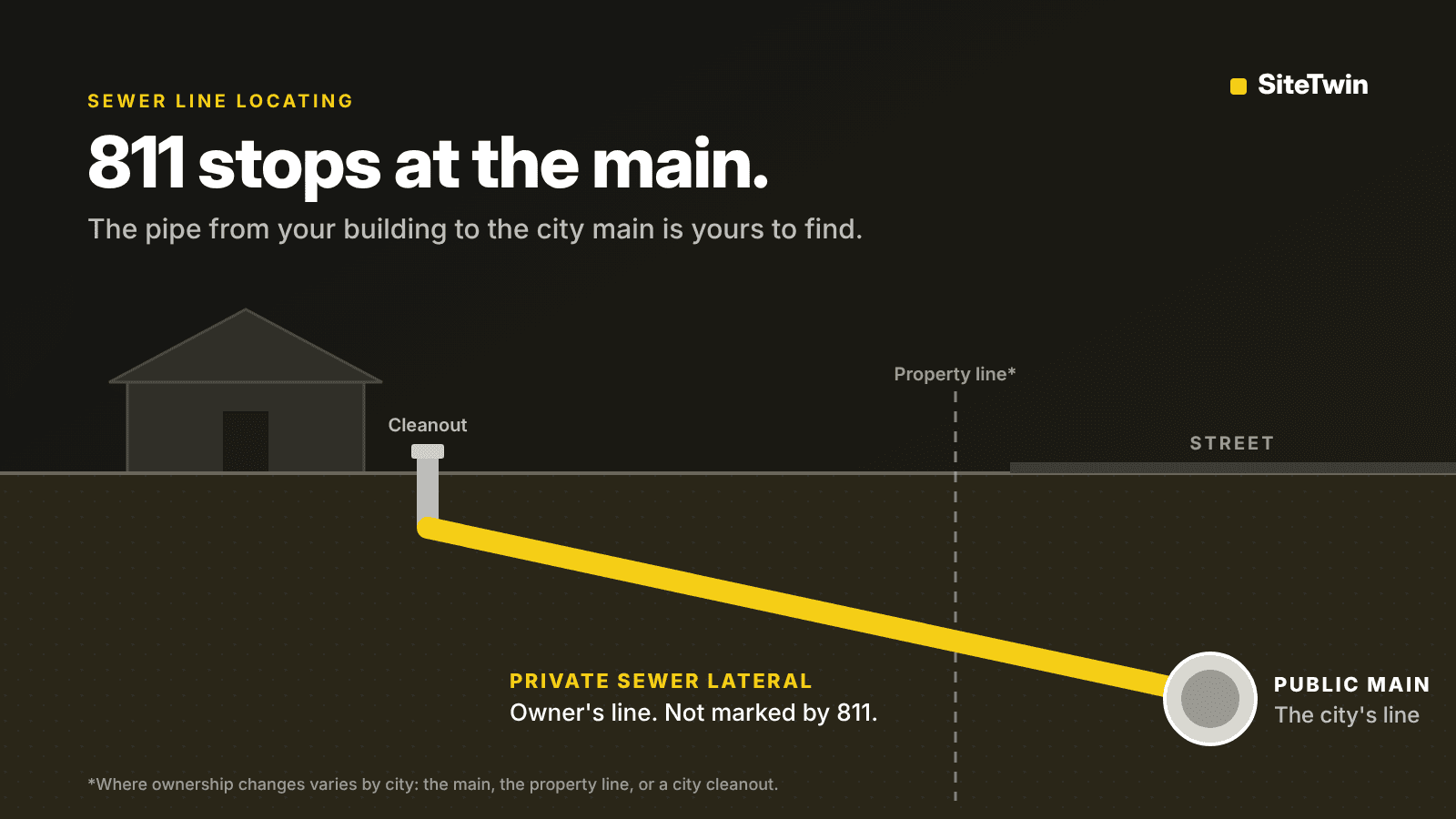
Your sewer line is the one buried line nobody is coming out to mark. Texas 811 stops at the public main, and the pipe that runs from your building to that main belongs to you. It is also usually PVC or clay, which means a standard utility locator can't see it.
Here is how sewer lines actually get found, from the quick checks you can do yourself to the methods we use on commercial sites.
Why 811 won't mark your sewer line
When you call 811, the system notifies the utility operators with lines in your area, and each one marks what it owns. The sewer lateral, the pipe that carries wastewater from your building to the city main, is generally the property owner's line. Nobody is notified to mark it.
Where your ownership ends depends on the city. Some draw the line at the main, some at the property line or sidewalk, and some at a city-owned cleanout. Your city's water or wastewater department can tell you where yours changes hands.
Still call 811. It covers the gas, electric, telecom and public water lines you may be digging near. It just won't cover this one. Our post on whether 811 covers private property in Texas explains the gap in more detail.
Why sewer lines are hard to find
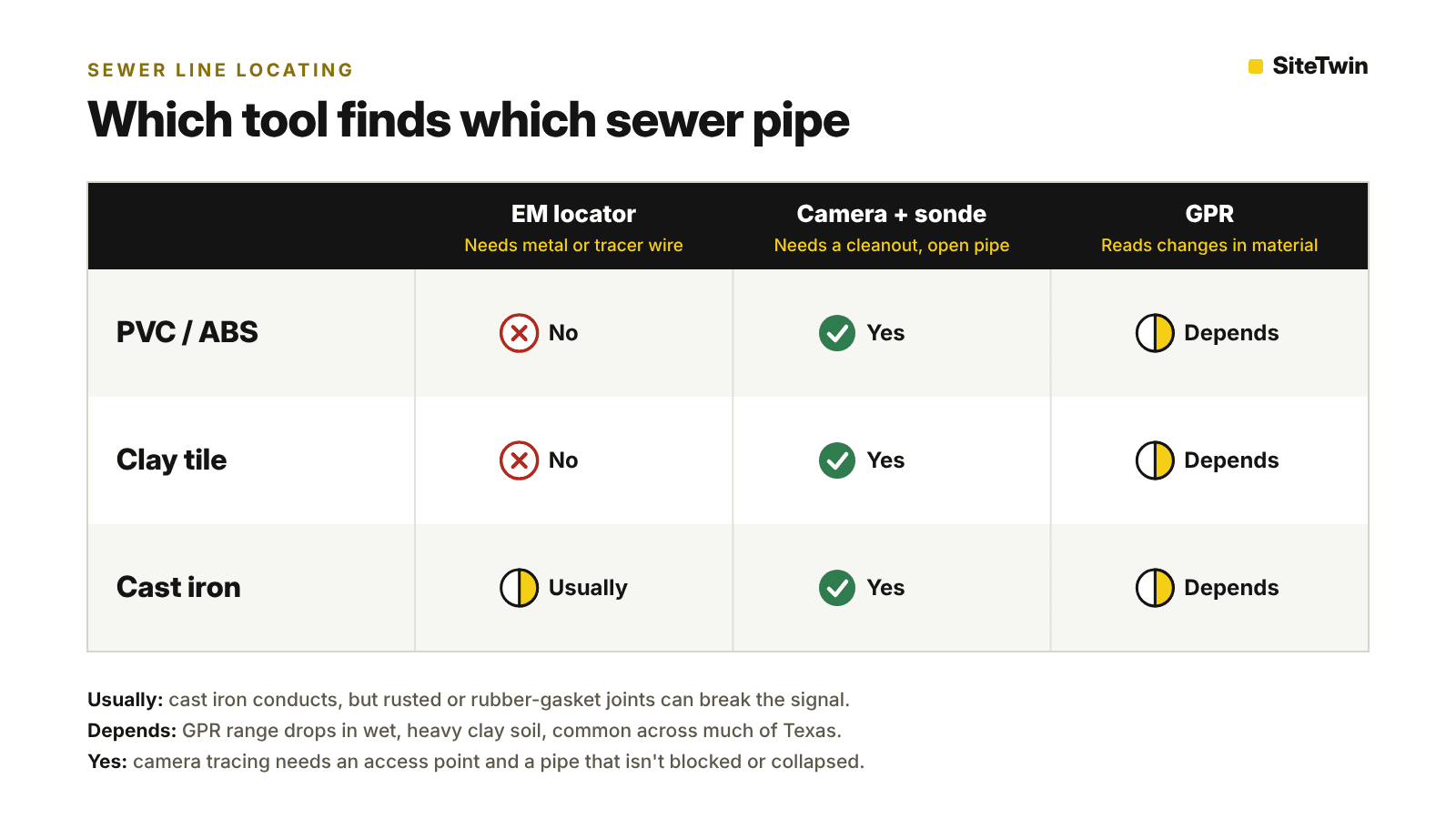
- They're usually not metal. Most laterals are PVC, ABS or clay tile, and older homes may have cast iron. Electromagnetic locators need a conductive pipe or a tracer wire, and sewer laterals almost never have tracer wire.
- They slope. Gravity does the work, so the line gets deeper as it runs toward the main. The depth at your foundation tells you very little about the depth at the street.
- They change over time. Repairs, reroutes and additions leave old pipe in the ground that doesn't show up on any drawing.
For typical burial depths of the other lines on a property, see our water line depth guide.
Start at the cleanout
The cleanout is a capped 3- or 4-inch pipe that gives access to the sewer line. Look near the foundation, usually on the side of the building facing the street, and check flower beds and under mulch. Many newer homes also have a second cleanout near the property line.
Two cleanouts give you a rough line. A sewer manhole in the street can tell you roughly where the main runs. That's enough to plan around. It is not enough to dig beside. Laterals bend, and the only way to know the path is to trace it.
On a septic property, the line runs to the tank instead of a city main. Our guide on how to find your septic tank covers that case.
Trace it with a camera and sonde
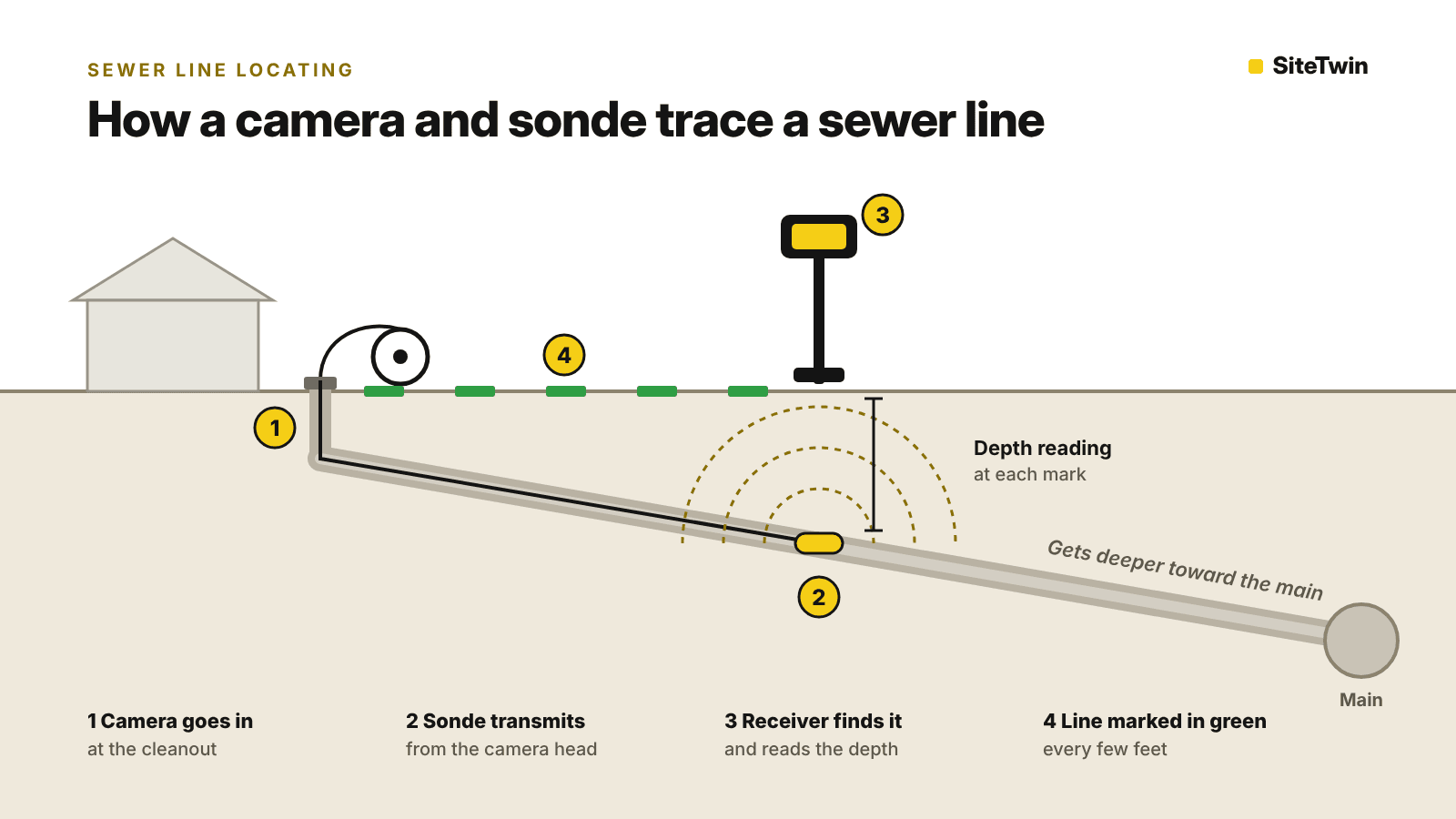
This is the most reliable way to locate a sewer line. A push camera goes into the cleanout with a small transmitter, called a sonde, near the camera head. Above ground, a receiver picks up the sonde's signal, so the operator can walk the line, mark it every few feet and take a depth reading at each mark.
You get the location and the condition in one pass. The camera shows root intrusion, sags, cracks, offset joints and where other lines tie in.
The limits: you need an access point, a blockage or collapse stops the camera, and every depth reading is an estimate. If you need an exact depth before boring across the line, verify it with a vacuum excavated pothole.
When a camera can't make the run, a fiberglass tracer rod with a built-in conductor can be pushed through instead and traced the same way.
Use GPR when there's no access
No cleanout, no way in, or a line that was abandoned years ago? Ground penetrating radar doesn't need a conductor. It reads changes in the material underground, so it can pick up PVC and clay pipe that an electromagnetic locator misses.
GPR has a real limit in much of Texas: clay. Wet, heavy clay soils absorb the radar signal, and in the worst ground the useful scanning depth can drop to just a few feet. That's why we pair GPR with sonde tracing wherever we can get access, and why we tell you where coverage was limited instead of drawing a confident line through it.
Sewer lines on commercial and redevelopment sites
Commercial ground is where sewer locating gets complicated. A site that has been through several tenants can have:
- more than one active lateral, each serving a different part of the building
- abandoned laterals from buildings that have since been demolished
- grease trap and interceptor lines that don't match the original drawings
- storm drains running close enough to be mistaken for sanitary sewer
Before trenching, boring or excavating, every active lateral should be traced and possible abandoned ones flagged. That's the work our private utility locating crews do every day.
What a sewer locate should give you
- Green paint marks on the ground. Green is the APWA color for sewer and drain lines.
- Depth readings at intervals along the run, not one number for the whole line.
- GPS points and a map (PDF and KMZ) so the locate is still usable after the paint fades.
- Notes on gaps: where the signal was lost or a section couldn't be verified.
Two things not to do
- Don't assume the line runs straight from the cleanout to the street.
- Don't trust one depth reading for the whole line. It gets deeper as it goes.
Frequently asked questions
Does 811 mark sewer lines?
811 may notify the city about a public sewer main. The private lateral from your building to the main is not marked, because it belongs to the property owner.
Can a metal detector find a sewer line?
Only if the pipe is cast iron and shallow. PVC, ABS and clay pipe won't register on a metal detector or a standard utility locator.
Can you locate a sewer line without a cleanout?
Yes. A camera can sometimes go in through a pulled toilet or another access point, and GPR can scan for the line from the surface with no access at all.
Who is responsible for the sewer line on my property?
Generally the property owner, from the building out to the main or to the city's connection point. The exact handoff point varies by city, so check with your city's utility department.
How deep is a sewer line buried?
There's no single number. Sewer lines slope toward the main, so they are shallowest at the building and deepest near the street. Depth readings taken along the run are the only reliable answer.
Need the sewer line found before you dig?
Send us the address and what you're planning to dig, trench or bore. We'll trace the line, mark it and send you the map. Send the address and scope or call 512-968-5660.